
Introduction
Shiva is one of the principal deities in Hinduism, worshipped as the supreme god by Shaiva Hindus across India, Nepal, Southeast Asia, and the global Hindu diaspora. Within the Hindu Trimurti — also called the Hindu triumvirate — Brahma is the creator, Vishnu is the preserver, and Shiva is the destroyer. But Shiva’s destruction is not annihilation. It is destruction and recreation: the dissolution of one cosmic cycle so the next can begin.
Lord Shiva holds multiple mythological roots. He is traced to the Vedic deity Rudra, connected to the Indus Valley Civilization through the disputed Pashupati seal, and developed across centuries of Hindu literature, temple sculpture, and Indian spiritual traditions. This page covers Shiva’s identity, iconography, mythology, temples, festivals, and his role in Hindu philosophy, art, and devotional life.
Shiva is represented in a vast range of forms. He appears in Hindu texts as an ascetic yogi seated in deep meditation on Mount Kailash, a fierce destroyer who reduces the triple city of demons to ash, a loving husband to the goddess Parvati, and the cosmic dancer Nataraja — Lord of the Dance — whose Tandava creates and dissolves the universe. This range of forms — from pacific mood to terrifying manner — makes Shiva one of the most complex figures in world religions.
Who Is Lord Shiva in the Hindu Triumvirate?
The Hindu triumvirate assigns three cosmic functions to three gods. Brahma is the creator who brings the universe into being. Vishnu is the preserver who maintains cosmic order through incarnations such as Rama and Krishna. Shiva is the destroyer who dissolves the universe at the end of each cosmic age so that creation can restart.
Shaiva Hindus regard Shiva not merely as the destroyer but as the supreme being who encompasses all three functions. In Shaiva Siddhanta theology, Shiva is pure consciousness — the unchanging reality behind all existence. Advaita Vedanta philosophy, associated with the Vedanta philosopher Shankara, identifies Shiva with the formless absolute. These theological positions distinguish Shiva worship from Vaishnavism, where Vishnu and Shiva occupy different roles in the cosmic hierarchy.
The syllable Om (also written Aum) connects directly to Shiva in many Hindu traditions. The mantra Aum Namah Shivaya — meaning “I bow to Shiva” — is the central devotional chant in Shaivism and one of the most recited mantras in all of Hinduism.
Shiva’s Origins: From Vedic Deity Rudra to Supreme God
The Vedic Period
Shiva’s early history traces to the Vedic deity Rudra, a fierce god of storms and destruction described in the Vedas. The Shatarudriya hymn in the Yajur Veda (specifically the Taittiriya Samhita) addresses Rudra with a thousand names, many of which became epithets of Lord Shiva. Rudra is called the Howler in Vedic texts — a deity associated with fear, disease, and healing. The earliest recorded Shaiva worshippers appear to have adopted Rudra’s fierce attributes and merged them with ascetic practices that would define later Shaivism.
The Indus Valley Civilization Connection
A contested subject in Indian philosophy involves the Pashupati seal discovered at Mohenjo-Daro, a site of the Indus Valley Civilization. The seal depicts a seated figure wearing a large headdress, surrounded by animals — including what appear to be a bull, an elephant, a tiger, and a rhinoceros. Some scholars perceive a likeness between this ancient seal and later depictions of ascetic Shiva as Pashupati, Lord of Cattle. This identification remains disputed among historians studying the early form of Shiva worship in antiquity.
Development in the Epics and Puranas
Shiva’s role grew significantly in the Hindu epics — the Ramayana and the Mahabharata — and in the Puranas, particularly the Shiva Purana. The Shvetashvatara Upanishad, composed before the Common Era, identifies Shiva as a supreme deity and marks a turning point in the emergence of Shaivism as a distinct theistic tradition.
By the early centuries of the Common Era, Shiva had risen from the Vedic deity Rudra to a god worshipped across the subcontinent. Indian philosophy records this development through multiple literary and sculptural traditions.
Names and Epithets of Lord Shiva
Lord Shiva is known by hundreds of names across Sanskrit, Tamil, and regional Indian languages. Each name identifies a specific attribute, form, or mythological role.
- Mahadeva (Great God): The most common epithet for Lord Shiva as supreme deity.
- Nataraja (Lord of the Dance): Shiva as cosmic dancer performing the Tandava.
- Pashupati (Lord of Cattle / Lord of Animals): Shiva as protector and master of all living beings.
- Neelakantha (Blue Throat / Blue Neck): Named for the Halahala poison held in Shiva’s throat.
- Chandrashekhara (Lord of the Moon): Shiva wearing the crescent moon in his matted locks.
- Dakshinamurti (Lord Who Faces South): Shiva as the first teacher, facing south while instructing sages.
- Bhairava (The Fierce One): Shiva’s terrifying manifestation, associated with cremation grounds and skulls.
- Mahakala (Great Time): Shiva as the lord of time and death who conquers death itself.
- Pashupata (Lord of the Innocent): An epithet connected to the Pashupata Shaiva tradition, one of the oldest Shaiva sects.
These names are not interchangeable labels. Each one carries a distinct theological and mythological reference, and each form of Lord Shiva connects to specific rituals, temple traditions, and scriptural sources.
Shiva’s Iconography: The Third Eye, Crescent Moon, and Blue Throat
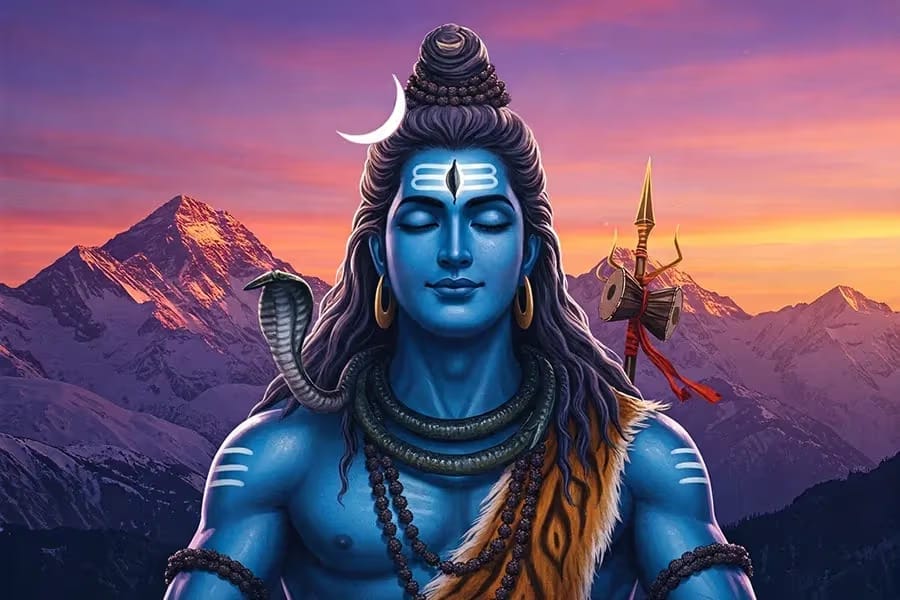
Shiva is represented in Hindu art through a system of visual attributes. Each element of his iconography carries specific symbolic meaning, recognized across temple sculpture, bronze casting, watercolor painting, and devotional images.
The Third Eye
Shiva’s third eye, located on his forehead, represents the fire of destruction and the power of higher consciousness. The third eye represents Shiva’s capacity to perceive what lies beyond ordinary sight. When Shiva opens his third eye, he can destroy with a single glance. In the myth of the Burning of Kama, Shiva burns Kama — the god of desire and personification of love — to ash with his third eye when Kama attempts to break Shiva’s deep meditation. Shiva conquers death, desire, and illusion through this power.
Crescent Moon and Matted Locks
A crescent moon sits in Shiva’s matted locks — the long, coiled hair of an ascetic. The epithet Chandrashekhara, Lord of the Moon, refers to this feature. The crescent moon connects Shiva to the monthly cycle of the moon’s wax and wane, and signals his control over time and cosmic rhythms.
Blue Throat (Neelakantha)
Shiva’s blue throat results from the Churning of the Ocean (Samudra Manthana). When the gods and demons churned the cosmic ocean, the Halahala poison emerged as a deadly side effect. The Halahala poison that emerged during the Churning threatened to destroy the universe. Lord Shiva drank the poison during the Churning as a protective act. The goddess Parvati pressed his throat, containing the poison. The poison turned Shiva’s throat blue, giving him the name Neelakantha (blue neck). Shiva’s blue throat stands as one of the most recognized attributes in Hindu iconography.
Matted Hair and the Ganges
Shiva’s matted locks represent his ascetic practice and his connection to the Descent of the Ganges. The holy river Ganga descends from heaven through Shiva’s hair, which breaks the river’s fall and prevents the Ganges from destroying the earth. This myth explains Shiva’s epithet Gangadhara (bearer of the Ganga).
Additional Iconographic Elements
- Trishula (Trident): Shiva’s primary weapon. The trident represents the three qualities of nature in Hindu philosophy — sattva (purity), rajas (activity), and tamas (inertia).
- Damaru (Small Hand Drum): An hourglass-shaped drum held in Shiva’s back right hand. The damaru produces the primordial sound of creation.
- Bhasma (Sacred Ash): Shiva’s body is covered in ash (vibhuti), applied as three horizontal stripes (tripundra) on the forehead, emphasizing his identity as lord of the cremation grounds.
- Tiger Skin: Shiva is depicted wearing a tiger skin or deerskin, marking his mastery over animal nature.
- Serpent (Vasuki): A serpent around his neck — the snake represents Shiva’s power over fear, death, and the cycle of time.
- Nandi (Bull): Shiva’s vehicle (vahana) is the bull Nandi, who guards the main sanctuary of every Shiva temple.
- Garland of Skulls: In his fierce forms, Shiva wears a garland of skulls, connecting him to the cremation ground and the impermanence of all physical existence.
- Pinaka (Bow): A weapon associated with Lord Shiva in Vedic and epic literature.
Forms of Lord Shiva: The Five Faces and Key Manifestations
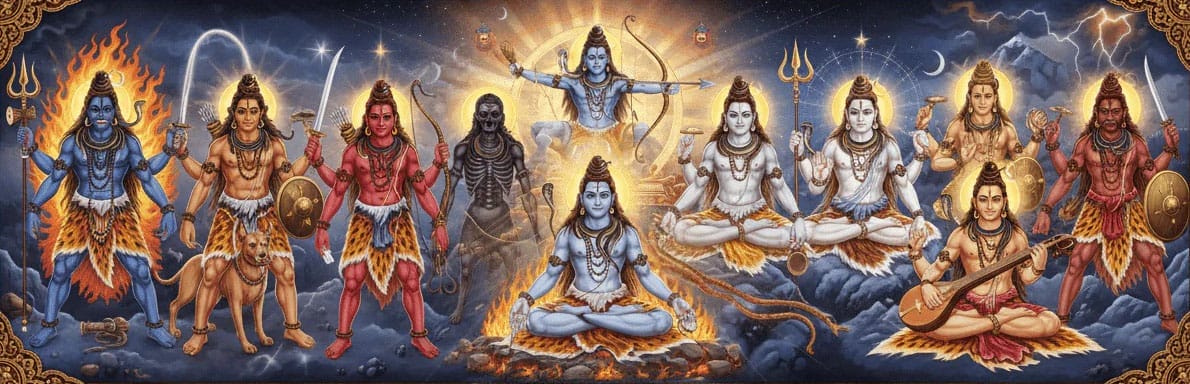
Shiva is represented in many forms across Hindu scripture and art. Each form of Lord Shiva addresses a different aspect of his cosmic role — from creator to destroyer, from ascetic to householder, from silent teacher to cosmic dancer.
The Five Faces (Panchavaktra)
Hindu texts describe each form of the Shiva through five principal faces, each linked to five elements and five cosmic functions.
| Face | Direction | Element | Attribute |
|---|---|---|---|
| Sadyojata | West | Earth | Creation |
| Vamadeva | North | Water | Preservation |
| Aghora | South | Fire | Destruction |
| Tatpurusha | East | Air | Concealment |
| Ishana | Skyward/Zenith | Space (Akasha) | Grace, spiritual liberation |
Shiva Nataraja: Lord of the Dance
Shiva Nataraja is the form of Lord Shiva as the cosmic dancer, performing the Tandava dance that creates and dissolves the universe at the end of each age. The Shiva Nataraja bronze statues produced during the Chola dynasty in Tamil Nadu are among the most recognized works of Indian art worldwide.
In the Shiva Nataraja depiction, Shiva dances within a flaming circle. His back right hand holds the damaru (drum). His front right hand displays the fear-not gesture (abhaya mudra), with the palm facing outward. His back left hand holds a flame. His uplifted left foot represents spiritual liberation, while his right foot is planted on a diminutive figure representing human ignorance. The dance portrays the continuous cycle of destruction and recreation — Shiva as Lord of the Dance destroying the old universe and bringing forth the new.
The Shiva Nataraja sculpture is displayed in major museums, including the Metropolitan Museum of Art in New York City, the Art Institute of Chicago, and the Victoria and Albert Museum in London.
Bhairava: The Fierce Manifestation
Bhairava is Shiva’s fierce manifestation, associated with the cremation ground, garland of skulls, and terrifying manner. In Shaiva mythology, Shiva emanates Bhairava when Brahma’s fifth head speaks an insult. Bhairava removes the offending head and then wanders as a skull-bearing beggar performing penance for this act. After the Destruction of Daksha’s sacrifice, Shiva weeps and rages — another instance of his fierce emotion recorded in the Puranas. The Kapalika tradition and Shaiva ascetics who pursued esoteric rituals at cremation grounds revered Bhairava as their central deity.
Dakshinamurti: Lord Who Faces South
Dakshinamurti — the Lord Who Faces South — depicts Shiva as the first teacher (Adi Guru), seated beneath a banyan tree, teaching the sages through silence. Ascetic Shiva in this form represents the source of knowledge, yoga, music, and all forms of learning. Sadhguru explains this form of Shiva as the origin of the yogic sciences — Shiva the Adiyogi, the first yogi who transmitted the methods of inner experience to humanity.
Ardhanarishvara: Half-Male, Half-Female
Ardhanarishvara portrays Shiva and Shakti (the goddess Parvati) in one body — half male, half female. The right half depicts Shiva, while the left half depicts Parvati. This form of Lord Shiva represents the unity of masculine and feminine power within the divine.
Lingodbhava: The Endless Pillar
In the Lingodbhava myth, Shiva appears as a blazing pillar of fire with no beginning and no end. Brahma, taking the form of a swan, flies upward seeking the pillar’s top. Vishnu, in the form of a boar, digs deep searching for the bottom. Neither can find the pillar’s limits. This myth — in which Vishnu and Shiva and Brahma interact — establishes Lord Shiva’s supremacy within the Hindu triumvirate.
Tripurantaka: Destruction of Tripura
In the myth of the Destruction of Tripura, Lord Shiva destroys the three fortified cities (Tripura) of the demon brothers with a single arrow. The asura brothers Tarakaksha and his kin had grown invincible in their flying fortresses. Shiva, mounted on a divine chariot, releases one arrow that pierces all three cities and reduces them to ash. This narrative establishes Shiva’s role as protector of the gods and destroyer of demonic power.
Shiva’s Mythology: Key Myths and Puranic Narratives
Daksha’s Sacrifice and the Destruction of Daksha
Daksha’s sacrifice is one of the central myths in Shiva’s mythology. Daksha, a Prajapati (lord of creation) and father of Sati, organizes a grand Vedic sacrifice but deliberately excludes his son-in-law Shiva. The Goddess Sati, humiliated by her father’s insult, self-immolates at the sacrificial ground.
When Shiva learns of Sati’s death, Shiva weeps terribly and enters a state of grief and rage. He sends his fearsome attendants (ganas) to the ritual site. Shiva destroys Daksha’s sacrifice, and in some versions, beheads Daksha himself. The Destruction of Daksha’s sacrifice marks a collision between Hindu orthodoxy — the Brahminical sacrificial tradition — and the rising Shaiva devotional movement. The places where Sati’s body falls become the Shakti Pithas, sacred sites of goddess worship across South Asia.
Sati is later reborn as Parvati, daughter of the mountain god Himavat, setting in motion the second great cycle of Shiva’s divine marriage.
The Wedding of Shiva and Parvati
After Sati’s death, Lord Shiva withdraws into celibate meditation on Mount Kailash. The gods need Shiva to produce a son — a war god born to defeat the demon Taraka. They send Kama, the god of desire, to awaken Shiva. Shiva burns Kama to ash with his third eye (the Burning of Kama), but Parvati’s penance eventually draws him back.
The 5th-century poet and playwright Kalidasa recounts Parvati’s journey in the epic poem Kumarasambhava. The wedding of Shiva and Parvati is a central event in Hindu mythology, depicted in temple sculpture at sites including the Ellora Caves in Maharashtra, India, with the Hindu god Brahma officiating the ceremony.
Together, the divine couple Shiva and Parvati represent the union of pure consciousness (Shiva) and feminine power (Shakti).
The Churning of the Ocean (Samudra Manthana)
During the Churning of the Ocean, gods and demons churn the cosmic sea using Mount Mandara as the churning rod and the serpent Vasuki as the churning rope. The Halahala poison that emerged during the Churning threatened all of creation. Lord Shiva drank the poison during the Churning to save the universe from destruction. The goddess Parvati pressed his throat, trapping the poison and turning it blue.
The Descent of the Ganges
The Descent of the Ganges is another foundational myth. The sage Bhagiratha performs severe austerities to bring the river Ganga down from heaven to purify the ashes of his ancestors. The force of the river’s fall would destroy the earth, so Lord Shiva catches the Ganges in his matted locks, channeling the river’s flow safely to the ground.
Shiva’s Family: Parvati, Ganesha, and Skanda
Parvati: Goddess and Consort
The goddess Parvati is Shiva’s wife and female consort. Shiva and Parvati together form the divine couple at the center of Shaiva household worship. Parvati is a reincarnation of the Goddess Sati. Born as a daughter of Himavat (the Himalaya mountain god), Parvati performs severe penance to win Lord Shiva as her husband back from his ascetic withdrawal.
Ganesha: The Elephant-Headed God
Ganesha, the elephant-headed god, is the son of Shiva and Parvati. In the most common myth, Parvati creates Ganesha from sandalwood paste to guard her while she takes a bath. When Shiva returns and the young boy refuses him entry, an angered Shiva removes the child’s head. Parvati’s grief moves Shiva to replace the head with an elephant head. Ganesha is worshipped as the remover of obstacles and is invoked at the beginning of new ventures across the Hindu world.
Skanda (Karttikeya): The Six-Headed War God
Skanda (also called Karttikeya or Kumara) is the son of Shiva — a six-headed war god born to destroy the demon Taraka. Shiva’s semen is carried by Agni (the fire god) and deposited in the river Ganges, then raised by the Krittikas (the Pleiades cluster). Skanda holds great significance in Southern India, Sri Lanka, and Southeast Asia. Major Skanda temples stand in Tamil Nadu and Karnataka.
The Shiva Linga: Aniconic Worship, Myths, and Interpretations
The Shiva Linga (also written Shiva Lingam or Linga) is the primary object of worship in Shiva temples worldwide. The Shiva Linga is an abstract, aniconic representation of Lord Shiva — typically a smooth cylindrical stone set within a yoni (a flat, rimmed base representing the goddess Shakti). Lingam myths and interpretations vary across Hindu traditions, from purely abstract symbols of formless divinity to associations with fertility and cosmic creation.
Lingam Myths and Interpretations
In the Lingodbhava narrative, the Lingam represents the endless pillar of fire from which Shiva emerges — a form without beginning or end. The Shvetashvatara Upanishad and later Shaiva Siddhanta texts describe the Lingam as a votary object representing Shiva’s role as the source and dissolution point of all creation. Some scholars identify the Lingam as a phallic symbol connected to fertility rites, though many Hindu traditions regard it as an abstract symbol of Shiva’s formless divinity. The debate between these interpretations has continued for over a century in both Indian and Western scholarship.
Types of Lingam
- Svayambhu Lingam: A self-manifested Lingam formed naturally, such as the ice Lingam at Amarnath. The ice Lingam draws thousands of pilgrims annually to the Amarnath cave in the Himalayas, where a stalagmite forms from dripping water and is revered as a natural manifestation of Shiva.
- Jyotir Lingas: The twelve Jyotir Lingas (Lingams of light) are the most sacred Shiva Lingas across India (see the temple section below).
- Carved Lingam: A stone Lingam installed in the main sanctuary of a Shiva temple, often adorned with offerings of milk, water, tamarind juice, and flowers.
- Mukha Lingam: A Lingam adorned with one or more carved faces of Shiva.
Major Shiva Temples and Pilgrimage Sites
The Twelve Jyotir Lingas
The twelve Jyotir Lingas are the most sacred Shiva temples across India. Each marks a site where Lord Shiva appeared as a divine pillar of light.
| Jyotir Linga | Location |
|---|---|
| Somnath | Gujarat |
| Mahakaleshwar | Ujjain, Madhya Pradesh |
| Omkareshwar | Madhya Pradesh |
| Bhimashankar | Maharashtra |
| Trimbakeshwar | Maharashtra |
| Vaidyanath | Jharkhand |
| Kashi Vishwanath | Varanasi (Kashi) |
| Ramanathaswamy (Rameswaram) | Tamil Nadu |
| Srisailam | Andhra Pradesh |
| Amarnath | Kashmir |
| Kedarnath | Uttarakhand (Himalayas) |
| Mallikarjuna | Srisailam, Andhra Pradesh |
Other Significant Shiva Temples
- Chidambaram Temple, Tamil Nadu: Houses the Shiva Nataraja — the main devotional image of Shiva as cosmic dancer. The temple sanctuary contains an empty space (Chidambara Rahasyam), representing Shiva as formless consciousness.
- Pashupatinath Temple, Kathmandu, Nepal: One of the most sacred Shiva temples in South Asia, located on the banks of the Bagmati River and serving as a Hindu cremation site.
- Kashi Vishwanath Temple, Varanasi: Located in the ancient city of Varanasi (Kashi), regarded as Shiva’s eternal dwelling place on earth. The Kashi Vishwanath Temple is one of the most visited pilgrimage sites in India.
- Ellora Caves, Maharashtra: Rock-cut cave temples featuring carved depictions of Lord Shiva, including the Shiva and Parvati wedding scene.
- Madurai Meenakshi Temple, Tamil Nadu: A massive temple complex dedicated to the goddess Parvati (as Meenakshi) and Lord Shiva.
Shiva Temples in Nepal, Southeast Asia, and the Indian Diaspora
Shiva temples are found throughout Nepal, Bangladesh, and Southeast Asia, including in Indonesia, where Hindu tradition shaped art, architecture, and culture for over a thousand years. The Indian diaspora has established Shiva temples in cities across North America, Europe, and Australia, sustaining worship and festival traditions far from the subcontinent.
Shiva Festivals and Observances
Maha Shivaratri (The Great Night of Shiva)
Maha Shivaratri — the Great Night of Shiva — is the most significant festival dedicated to Lord Shiva, observed annually on the dark half (waning moon) of the lunar month of Phalguna (February–March). Devotees stay awake through the Night of Shiva, chanting Aum Namah Shivaya, offering milk and water to the Shiva Linga, and performing meditation. The festival marks the night Lord Shiva performs the cosmic Tandava dance.
Maha Shivaratri is observed across India, Nepal, and by Hindu communities worldwide.
Other Festivals Connected to Lord Shiva
- The month of Shravana: A period of particular devotion to Shiva, marked by daily puja (worship), fasting, and pilgrimage.
- Guru Purnima: A holiday honoring spiritual teachers, with particular importance for Shaiva Hindus who regard Shiva as the first teacher (Dakshinamurti).
- Holi: While primarily a festival of colors associated with Vishnu and Krishna, the mythology of Holi includes the Burning of Kama — the story of Shiva burns Kama with his third eye — connecting the festival to Shiva’s mythology.
Shiva in Hindu Philosophy, Yoga, and Indian Spiritual Traditions
Shiva the Adiyogi: The First Yogi
Hindu tradition identifies Shiva as the first yogi — the Adiyogi — who originated yoga practice, meditation, and asceticism. Shiva the Adiyogi is not merely a mythological figure but the foundational teacher of Indian spiritual traditions related to inner transformation. Sadhguru explains that Shiva the Adiyogi transmitted the science of yoga to the Saptarishis (seven sages) at Kanti Sarovar near Kedarnath, establishing the yogic tradition that spread across all of South Asia. Depictions of ascetic Shiva seated in deep meditation, often on Mount Kailash in the Himalayas, connect him to the practice of tapas (austerity) and renunciation.
Shaivism: The Worship of Shiva
Shaivism is one of the major Hindu traditions, alongside Vaishnavism (devotion to Vishnu) and Shaktism (devotion to the goddess). Those who worship Shiva as the supreme god seek moksha — spiritual liberation from the cycle of rebirth (samsara) — through devotion, meditation, and ritual practice.
Key Shaiva philosophical systems include:
- Shaiva Siddhanta: A dualistic theology prominent in Southern India and Tamil Nadu, with a systematic temple worship tradition.
- Kashmir Shaivism: A non-dualistic tradition centered in Kashmir, India, articulated in the Shiva Sutras and related tantric texts.
- Pashupata: One of the oldest Shaiva sects. The earliest recorded Shaiva traditions include the Pashupata ascetics, who practiced extreme austerities and pursued esoteric rituals outside the boundaries of Hindu orthodoxy.
- Lingayatism: Founded by the 12th-century reformer Basava in Karnataka, this tradition rejected caste hierarchy and centered worship on the Shiva Linga worn on the body.
Shiva and the Bhakti Tradition
The Bhakti tradition of devotional worship produced centuries of Hindu poetry and singing dedicated to Shiva, particularly in Tamil, Kannada, and Sanskrit. Tamil Shaiva poet-saints — the Nayanars — composed devotional works that remain central to worship in South Indian Shiva temples. The Shaiva ascetics of this period defined the devotional landscape of Southern India and shaped Hindu temple culture for centuries.
Shiva in Indian Art and Sculpture
Lord Shiva is one of the most depicted deities in Indian art, appearing in bronze sculpture, stone carving, watercolor on paper, copper alloy statues, and carved ivory across South Asia’s artistic traditions.
Chola Bronzes
The Chola dynasty of Tamil Nadu (9th–13th centuries CE) produced Shiva Nataraja bronze statues that stand among the finest works of world sculpture. These bronzes portray Shiva performing the cosmic dance with four arms, standing within a flaming circle. The National Museum of India in New Delhi and the Metropolitan Museum of Art in New York City house significant examples.
Kangra Style Painting
Miniature paintings from the Kangra style tradition (Himachal Pradesh, northwestern India) depict the divine couple Shiva and Parvati seated together in the Himalayas, accompanied by Nandi the bull and their children Ganesha and Skanda.
Cave and Temple Sculpture
Rock-cut sculptures at Ellora and other cave sites in Maharashtra depict Shiva’s mythology in stone relief — including the wedding of Shiva and Parvati, Shiva Nataraja, and the Lingodbhava. These works demonstrate how Shiva is represented in monumental Indian art across centuries.
Shiva in the Indian Diaspora and Modern Hinduism
Shiva worship extends beyond South Asia through the Indian diaspora. Hindu temples dedicated to Lord Shiva — including the Shivoham Shiva Temple and similar institutions — serve diaspora communities across North America, Europe, Southeast Asia, and Australia.
In modern Hinduism, Lord Shiva remains central to daily life for hundreds of millions of Hindus. His image appears in homes, businesses, and public spaces. The concept of Shiva the Adiyogi has connected Shiva to the global practice of yoga and meditation, though practitioners and scholars continue to debate the boundaries of this association. Sadhguru explains Shiva’s relevance to contemporary seekers through the Isha Foundation’s programs, bringing the Adiyogi concept to international audiences.
Conclusion
Lord Shiva — the Hindu god of destruction and recreation, meditation, and cosmic dance — holds a position of supreme importance in Hinduism, Shaiva theology, Indian art, and Hindu devotional life across South Asia, Nepal, Southeast Asia, and the global Indian diaspora. From the Vedic deity Rudra to the Shiva Nataraja bronzes of Chola-era Tamil Nadu, from the ice Lingam at Amarnath to the Maha Shivaratri celebrations observed worldwide, every form of Lord Shiva connects to living traditions of worship, festival, and pilgrimage. Understanding Shiva requires attention to his iconography, his family (Parvati, Ganesha, Skanda), the Shiva Linga as the center of temple worship, and the philosophical traditions — Shaiva Siddhanta, Kashmir Shaivism, and the legacy of Shaiva ascetics and the 12th-century reformer Basava — that have shaped how over a billion Hindus relate to this deity.