
Introduction
Bhaktapur Durbar Square is a former royal palace complex located in the ancient city of Bhaktapur, approximately 13 kilometers east of Kathmandu in Nepal’s Kathmandu Valley. UNESCO designated the square as a World Heritage Site in 1979, recognizing it as one of seven monument zones — alongside sites like Pashupatinath Temple and Changu Narayan — that represent the cultural heritage of the Kathmandu Valley. Visitors arriving at this well-known tourist destination encounter a dense concentration of temples, palaces, courtyards, and stone sculptures built primarily between the 15th and 18th centuries during the reign of the Malla dynasty.
The square served as the political, religious, and cultural center of the Bhaktapur Kingdom from the 14th century until 1769, when Prithvi Narayan Shah conquered the Kathmandu Valley and unified Nepal under the Gorkha dynasty. Today, Bhaktapur Municipality and the Archaeological Department of Nepal jointly manage the site, which functions as both a living urban center and an open-air museum of traditional Newari art and Nepalese architecture. The atmosphere of the square — filled with the sound of temple bells, the sight of Puja offerings, and the daily presence of Hindus and pilgrims — makes it a treasure trove of living heritage that few other landmarks in Nepal can match.
What Bhaktapur Durbar Square Is
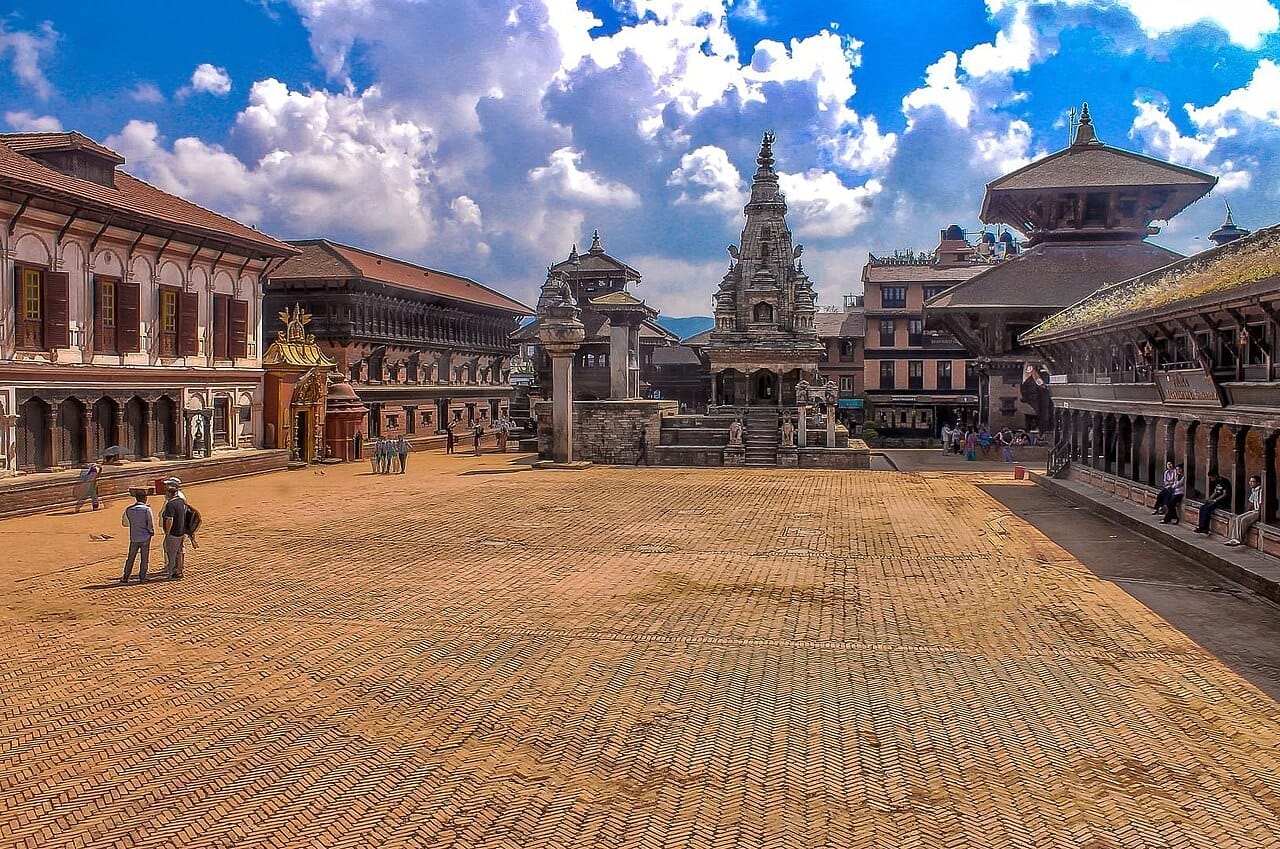
Bhaktapur Durbar Square consists of four interconnected public squares: Durbar Square proper, Taumadhi Square, Dattatreya Square, and Pottery Square. Each square contains distinct temples, monuments, and cultural sites built across several centuries by successive Malla kings. There are ruins scattered throughout the premises where buildings once stood before devastating earthquakes reduced them to rubble, and there are also fully reconstructed structures that preserve the original design and beauty of the Malla era.
The term “Durbar Square” translates from Nepali as “palace square.” The Newar people of Bhaktapur — also referred to as Newa or Newari people — use the term “Lyākū,” derived from the Sanskrit word “rājakula,” meaning “royal palace.” The city itself carries three names: Bhaktapur (City of Devotees), Khwopa (the local Newari name), and Bhadgaon (an older historical designation). Each name is rooted in the historic city’s identity as a center for Hindu worship and Newari culture.
Geographic Location and Access
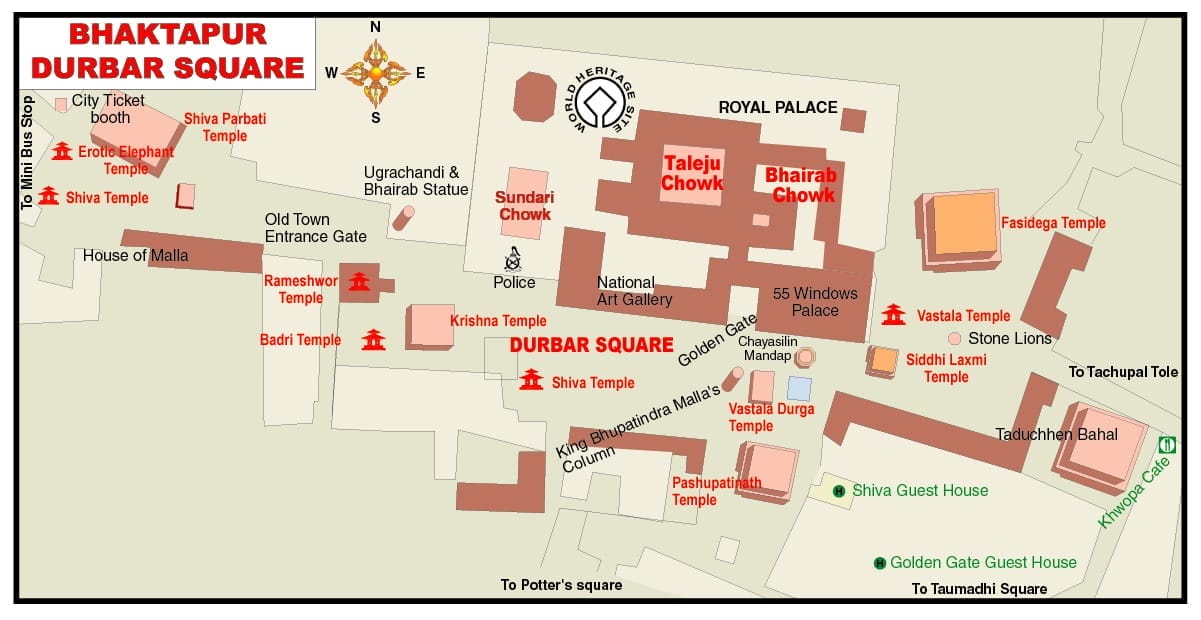
Bhaktapur Durbar Square sits at an elevation of 1,400 meters above sea level in the Bagmati Province of Nepal, within Bhaktapur District. The site covers approximately 6.88 hectares within Bhaktapur Municipality. The Arniko Highway connects Bhaktapur to Kathmandu, and a recent upgrade expanded a 9.1-kilometer stretch of the Kathmandu-Bhaktapur Road from two lanes to four lanes, reducing commuter travel time during peak hours. Visitors can check Google Maps for the most direct route before travelling.
Travelers reach Bhaktapur by local bus from the bus stand at Ratna Park or Koteshwor in Kathmandu, by tourist bus, by taxi (approximately 30 to 45 minutes depending on traffic), or by car. Buses run regularly throughout the day from the bus stop near Ratna Park. An entrance fee applies: NRs 1,500 for non-SAARC nationals, NRs 500 for SAARC and Chinese citizens, and free entry for Nepalese citizens and children under 10. There is no charge for entering the premises if you are a Nepalese citizen. The airport in Kathmandu is the nearest point of arrival for international visitors planning a trip to Bhaktapur.
History of the Malla Dynasty and Bhaktapur’s Royal Palace
The history of Bhaktapur Durbar Square is inseparable from the Malla dynasty, which ruled the Kathmandu Valley for over six centuries. King Ananda Malla is credited with founding the city in the 12th century, and Bhaktapur served as the capital of the Greater Malla Kingdom until the 15th century. Inscriptions found in the square and surrounding courtyards provide research material for historians studying the Lichhavi and Malla periods.
Key Malla Kings and Their Contributions
Three kings left the deepest imprint on the square’s architecture and layout.
Yakshya Malla (also written as Yaksha Malla) ruled in the 15th century and presided over the last unified Malla Kingdom — the whole kingdom stretching across the Kathmandu Valley. After his death, the kingdom split into three independent city-states: Bhaktapur, Kathmandu, and Patan (Lalitpur). Each city-state developed its own Durbar Square, and the rivalry between the three kingdoms drove an era of competitive temple construction and artistic patronage.
Jayasthiti Malla is credited with building the very first palace in the current Durbar area during the late 13th century, though no remains of that initial structure — then named Yuthuniman Rajkula — have survived. He established a foundation of court architecture and urban planning that later kings expanded.
Jitamitra Malla ruled Bhaktapur from 1663 to 1696. He contributed several structures to the palace complex and commissioned religious monuments that remain standing today, including hiti (traditional stone water spouts) and shrines decorated with inscriptions recording offerings to the Gods.
King Bhupatindra Malla ruled from 1696 to 1722 and is considered the most influential patron of art and architecture in Bhaktapur’s history. He commissioned the Nyatapola Temple, remodeled the Palace of Fifty-Five Windows, inaugurated the Golden Gate, and oversaw the carving of the stone sculptures of Ugracaṇdī and Ugrabhairava near the palace entrance. A bronze statue of King Bhupatindra Malla sits on a stone pedestal and pillar in front of the Golden Gate, depicting him in a posture of prayer — a symbol of his devotion to the Gods and the prosperity of the kingdom. His reign marked the most glorious period of artistic production in Bhaktapur.
The Fall of the Bhaktapur Kingdom
In 1768, Prithvi Narayan Shah of the Gorkha dynasty launched a military campaign across the Kathmandu Valley. By 1769, Bhaktapur fell, and King Ranjit Malla, the last Malla king of Bhaktapur, lost the throne. The palace square fell into disrepair under Gorkha and later Rana rule, as the former palace grounds were converted into government offices, schools, and private houses. Despite being cut off from royal funding, many of the square’s monuments survived through local customs of community maintenance and worship.
Major Monuments and Temples
The Palace of Fifty-Five Windows (Window Palace)
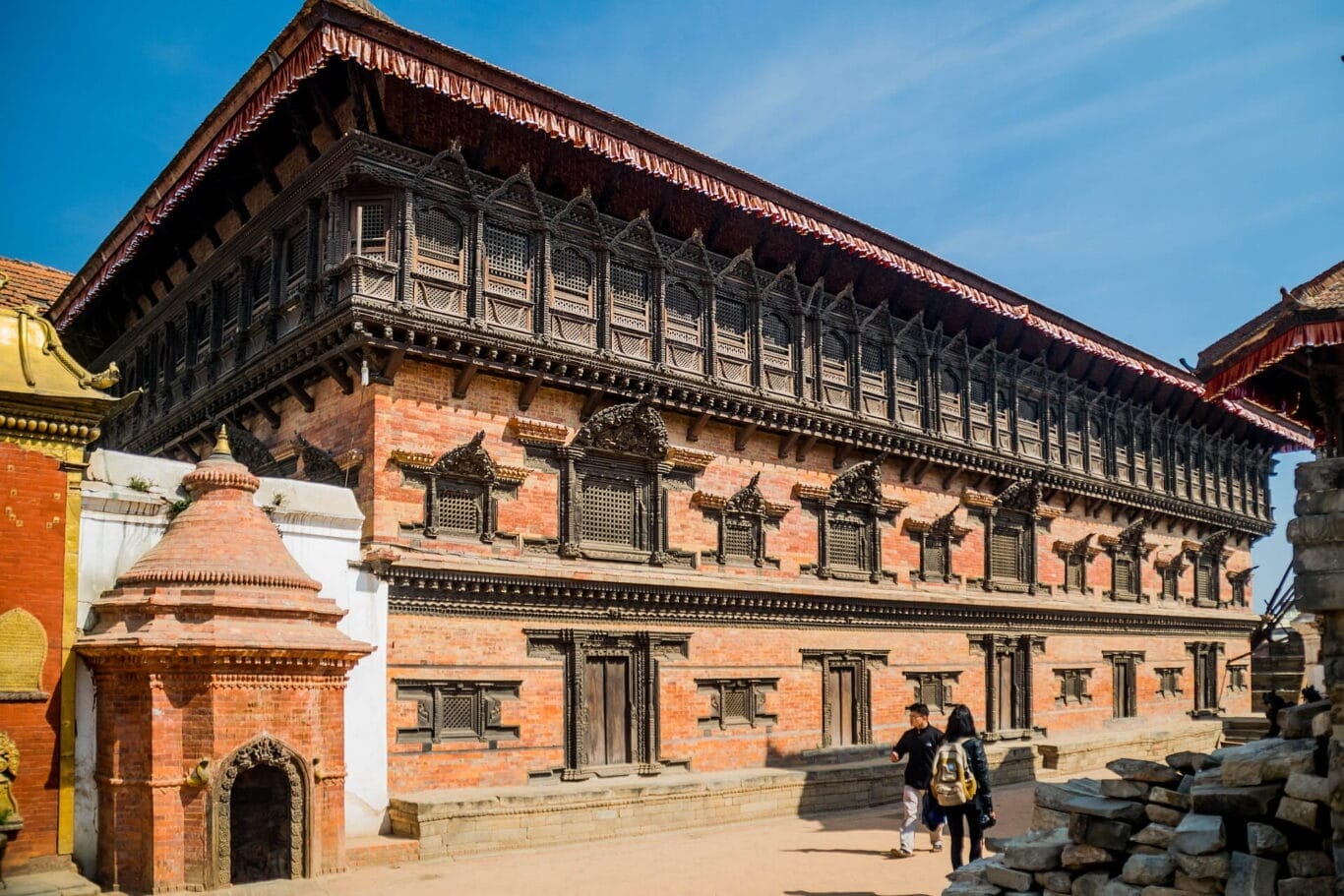
The Palace of Fifty-Five Windows — also referred to as the Window Palace or Windows Palace — is the principal royal palace building in Durbar Square. Its construction dates to 1427 AD, and King Bhupatindra Malla remodeled it during his reign in the late 17th century. The palace takes its name from a balcony featuring fifty-five intricately carved wooden windows, each displaying distinct patterns created by Newari woodcarving artisans. One can see a glimpse of the most beautiful Newar woodwork in the Kathmandu Valley through these carved windows and the carved peacock motifs that decorate the façade.
The palace stands as a multi-floor structure. Visitors can observe the second floor balcony from the square below, where the carved wood details are most concentrated. The ground floor of the palace now houses the National Art Gallery (also called the National Art Museum), which displays a collection of Hindu and Buddhist paintings, manuscripts, bronze sculptures, paubha (traditional Nepalese scroll paintings), and photographs spanning several centuries. The museum presents images of Hindu deities and Buddhist religious figures, along with wood carving samples, Yantra designs, and artifacts from the Malla period.
The Golden Gate (Luṁ Dhvākhā)
The Golden Gate serves as the main entrance to the inner courtyards of the royal palace. Covered in gilded copper and gold-plated bronze metalwork, this gate is considered one of the finest examples of repousse metalwork in Asia. The gate depicts Hindu deities including Garuda (the bird Garuda, a sacred symbol in Hinduism), Bhairava, Taleju, Hindu goddess Kali, and other Gods in detailed relief carvings. Percy Brown, an eminent English art critic and historian, described the Golden Gate as a jewel of medieval Nepalese art and a masterpiece of the whole kingdom’s artistic output.
Behind the Golden Gate lies the Mul Chowk, the main ceremonial courtyard of the palace. The court is surrounded by intricately decorated pillars and beams with stone carvings and wood carving details. The courtyard contains the Taleju Temple, dedicated to the goddess Taleju Bhawani, who served as the royal deity of the Malla kings. Access to the Taleju Temple remains restricted to Hindu worshippers during specific festivals, and visitors are asked to observe local customs by taking off shoes before entering any shrine on the premises.
Naga Pokhari (The Royal Bath)
The Naga Pokhari is a royal bath located within the palace courtyards. The small pond features stone nagas (serpent deities) coiled around its perimeter, with a gilded water spout shaped like a naga head at the center. Visitors can see a pair of stone figures — including a tortoise and a snake — placed in the pond. A carved stone post in the pond depicts the god Vishnu (Lord Vishnu) seated on the serpent Ananta. The bath served ceremonial and ritual purposes for the Malla royal family, and the water from the stone spout was considered a source of blessings and prosperity.
Nyatapola Temple
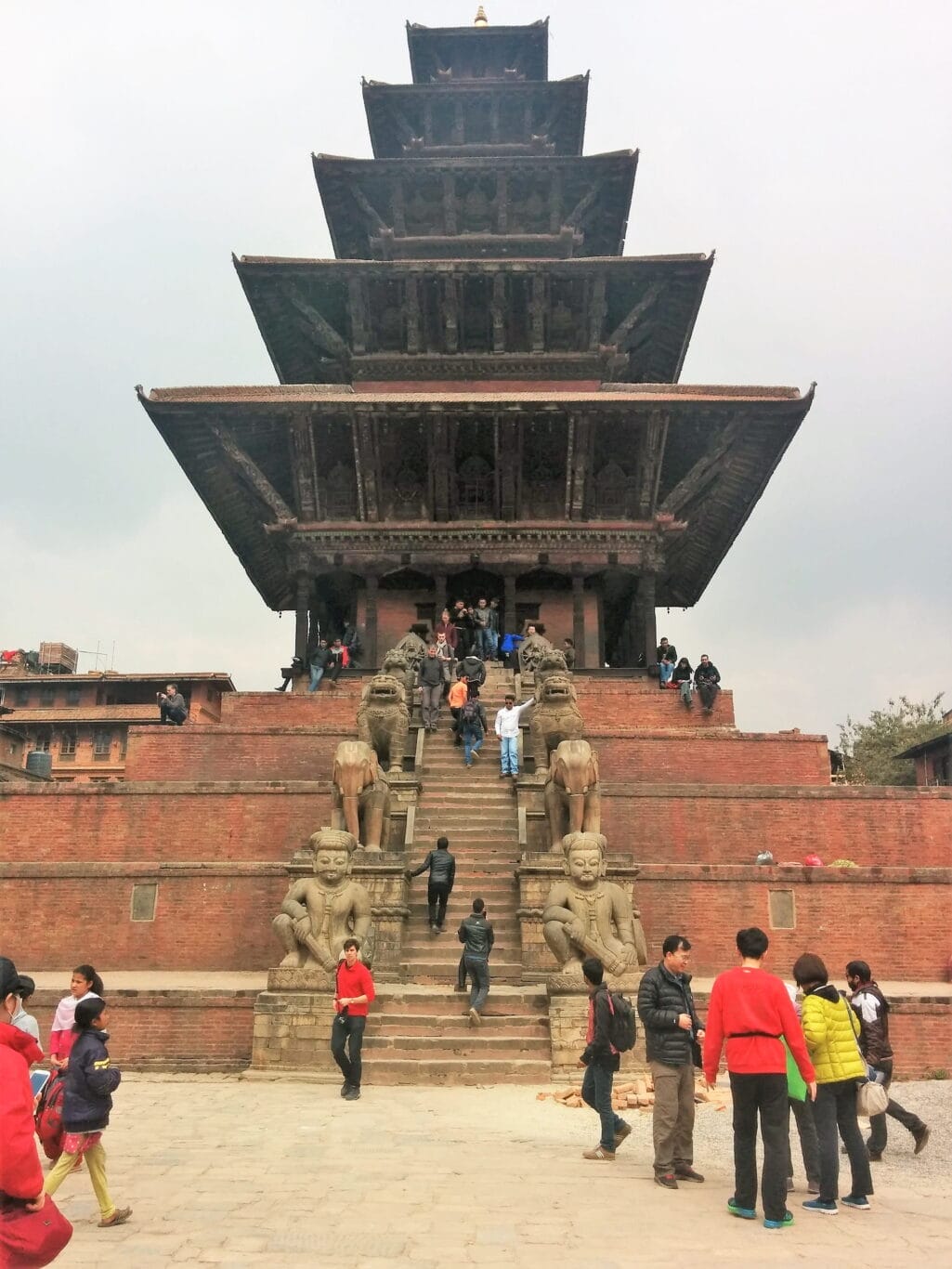
The Nyatapola Temple stands in Taumadhi Square, adjacent to Durbar Square. At 33 meters in height, it is the tallest pagoda-style temple in Nepal. King Bhupatindra Malla commissioned the temple in 1701, and workers completed the five-story structure within approximately 214 days — a fact noted for its speed given the absence of modern construction equipment.
The temple is dedicated to Siddhi Lakshmi (also written as Siddhi Laxmi), a Tantric incarnation of the mother goddess believed to be a fierce manifestation of Durga. The deity inside the temple remains locked behind a door that only designated priests are permitted to open. The image of the goddess is so powerful that it has never been shown to the public. The priest performs daily Puja rituals inside the inner sanctum.
A monumental stone staircase with steps leading to the temple entrance is flanked by five pairs of guardian figures arranged in ascending order of power: the wrestlers Jayamel and Phattu at the base (a pair of giant stone figures placed like a set of gatekeepers), followed by elephants, lions, griffins, and the goddesses Baghini (the Tigress) and Singhini (the Lioness) at the top. Each guardian is said to possess ten times the strength of the figure on the level below. The bull, commonly associated with Lord Shiva, does not appear in this sequence — the guardians instead progress through animals and mythical beasts toward divine female figures.
The temple’s name comes from the Newari language: “nyata” means five, and “pola” means roof or story. It is one of the only temples in Nepal named after its architectural dimensions rather than its resident deity. The five stories represent five elements: earth, water, fire, air, and sky (or space). The temple survived both the 1934 Nepal-Bihar earthquake and the 2015 earthquake with only minor damage, a result of its earthquake-resistant engineering with base isolation between the plinth and the upper timber-and-brick tower. The pagodas of the Nyatapola rise above the landscape of Bhaktapur and remain visible from a considerable distance, making the temple a landmark and symbol of the city. Photography of the temple and its guardian statues is permitted throughout.
Vatsala Temple and the Taleju Bell

The Vatsala Temple (also called Vatsala Durga Temple or Siddhi Vatsala) stood as a stone temple dedicated to Goddess Vatsala Devi, built in the Shikhara architectural style with sandstone walls and a pumpkin-like dome at its peak. The temple featured a large bell known as the big bell or the Bell of Barking Dogs. Locals believed that ringing the bell would ward off evil spirits and bring blessings, and the sound reportedly caused dogs in the area to bark. A separate Taleju Bell, placed right next to the palace, was rung by citizens seeking an audience with the Malla king.
The 2015 devastating earthquake demolished the Vatsala Temple. Restoration and reconstruction efforts continue, with teams working to preserve the original European style stonework and Shikhara design.
Bhairavnath Temple (Bhairab Nath Temple)
The Bhairavnath Temple (also called the Bhairab Nath Temple) in Taumadhi Square is dedicated to Bhairava (also written as Bhairav or Bhairab), a fierce manifestation of Lord Shiva. The three-story pagoda structure houses a small image of Bhairava that locals consider a powerful deity. The temple is central to the annual Bisket Jatra festival, during which a chariot carries the Bhairava image through the streets of Bhaktapur. Masked dances performed by locals depict the demon-slaying legends associated with Bhairava. The Mandir (temple) is one of the most famous religious sites in the square.
Jagannath Temple and Krishna Temple
The Jagannath Temple is situated on a raised platform near the palace complex and is dedicated to Lord Jagannath, an incarnation of Lord Vishnu worshipped by Hindus across Nepal and India. The temple features carved wooden struts depicting various incarnations of Vishnu. A short walk further brings visitors to the Krishna Temple, a stone temple with carvings of Krishna and other Hindu deities. Both temples are well-known examples of Nepalese pagoda and Shikhara style building traditions.
Dattatreya Temple
Dattatreya Temple anchors the eastern end of the square complex at Dattatreya Square. Dedicated to the deity Dattatreya — regarded as a combined incarnation of Brahma, Vishnu, and Shiva — the temple is believed to have been carved from a single tree. Two stone wrestlers guard the entrance, similar to those at the Nyatapola Temple. According to legend, the original timber structure was fashioned from one enormous tree trunk — a claim that draws interested visitors and historians alike.
Dattatreya Square also contains the Peacock Window, a carved wooden window depicting a carved peacock with a fanned tail. It is considered one of the most beautiful examples of Newari woodcarving in Nepal and a perfect place to observe the precision of Newar artisans. The window is tucked into the façade of a former monastery, and many people consider it the single most photographed piece of wood carving in the Kathmandu Valley.
Siddhi Lakshmi Temple
The stone Siddhi Lakshmi Temple stood near the southeastern corner of the palace complex. A stone staircase with steps leading to the temple entrance featured each step guarded by paired stone figures: men and women holding a child, horses, camels, mythical beasts, and deities. A female figure standing beside each male figure formed a pair on every level. The 2015 earthquake collapsed the temple. Restoration teams funded by international organizations and the Nepalese government are working to restore the structure.
Char Dham Temples
A replica of the Char Dham — the four sacred Hindu pilgrimage sites of India (Kedarnath, the Kedarnath Temple, Badrinath temple, Jagannath, and Rameshwar) — occupies the western part of the square complex. King Jagat Prakash Malla commissioned these shrines so that residents of Bhaktapur could complete a form of pilgrimage and worship at all four sacred sites without traveling to India. The Mandir structures are modest in size but carry deep religious significance for local Hindus and pilgrims.
Pashupatinath Temple Replica and Annapurna Temple
A replica of the Pashupatinath Temple (also called the Pasupatinath Temple) stands behind the Vatsala Temple area, dedicated to Lord Shiva as Pashupati (Pashupatinath). The shrine mirrors the form of the main Pashupatinath Temple in Kathmandu. Nearby, the Annapurna Temple is dedicated to the mother goddess Annapurna, a form of the Hindu goddess associated with food and prosperity. Devotees offer rice and grains at this shrine as part of daily Puja.
Additional Monuments and Landmarks
Visitors walking through the square can find a Nritya (dance) mandap — a raised platform or Mandap used for religious performances and music during festivals. Stone lions guard several palace gates, and a pair of stone lions placed right above the main steps serves as a well-known landmark for meeting points and sightseeing photography.
The Siddha Pokhari (also written as SIDDHA POKHARI) is a large pond situated near the entrance to the city. The pond — rectangular in shape — is surrounded by stone spouts and shaded by trees, giving it a peaceful atmosphere. Legends associate the pond with serpent deities, and birds gather along its edges at dawn.
Other notable structures include the Hanuman statue near the palace entrance, a Ganesh (also called Ganesh or Nritya Ganesh) shrine, and scattered hiti (stone spouts) that still provide water to local residents. The Mahadev shrine — dedicated to Lord Shiva in his form as Mahadev — is found in the palace courtyard, and visitors can observe a Puja being performed at this shrine during morning hours.
Art, Architecture, and Cultural Significance
Newar Architecture and Construction Techniques
Bhaktapur Durbar Square is a concentrated display of traditional Newar architecture, the indigenous building tradition of the Kathmandu Valley. The dominant styles include pagoda-style temples with multi-tiered roofs, Shikhara-style stone temples with pointed spires, and palace buildings with carved wooden windows, doors, and struts. The design of each structure reflects the religious and cultural traditions of the Newari people, who placed equal weight on beauty and structural durability.
The primary construction materials are fired brick, timber (especially sal wood), sandstone, and terracotta. Artisans used copper, bronze, and gold plating for decorative metalwork. Carved wooden roof struts — the angled supports beneath temple eaves — depict Hindu and Buddhist deities, nymphs, and religious scenes. The pillars inside the Mul Chowk feature detailed carvings of animals, including Cows, birds, and fish, all holding symbolic meaning in Hinduism. The floor of the courtyard is paved with brick in traditional patterns. A dome-shaped Kalash sits atop many of the temples as a decorative and religious element.
Woodcarving, Stone Sculpture, and Metalwork
The carved windows, doors, and struts throughout the square represent the work of Newari artisans across multiple centuries. The woodcarvings depict Hindu deities such as Vishnu, Shiva, Krishna, Ganesha (Ganesh), Lakshmi, Durga, and Narasimha, along with Buddhist symbols and Tantric imagery. Images of Indrayani, Balakhu, and Prajapati appear in less prominent shrines and on the beams of older buildings. The carved peacock on the Peacock Window and the carved wood struts throughout Dattatreya Square are considered the most beautiful examples of Newari art.
Stone sculptures include the guardian stone lions at the palace entrance, the paired wrestlers and mythical beasts on temple staircases, and free-standing statues of deities mounted on stone pedestals. Many of the stone carvings were quarried from Chovar and transported to Bhaktapur. Visitors can see a sculpture of the bird Garuda — the vehicle of Lord Vishnu — placed on a pedestal facing south in front of one of the temple entrances. Other carvings depict weapons, demons, and scenes from Hindu legends.
Bronze and gold-plated metalwork covers the Golden Gate, temple doors, and the national flag of Nepal displayed at government buildings within the square. The Kalash finials, gilded window frames, and metal roof ornaments reflect the metalworking traditions that reached their peak during the Malla era. Leather goods and souvenir items sold in the market near the square carry traditional Newari designs.
The National Art Gallery and Woodcarving Museum
The National Art Gallery inside the Palace of Fifty-Five Windows displays paintings, manuscripts, and metal sculptures from the Malla period. The collection includes paubha paintings, images of Hindu and Buddhist deities, photographs, and bronze religious artifacts. Visitors can observe inscriptions, Yantra designs, and weapons from the Malla court on the second floor of the museum. A PDF guide is available at some ticket counters for reference.
The Woodcarving Museum in Dattatreya Square occupies a former monastery and houses a collection of carved wooden windows, struts, and decorative panels that survived earthquake damage. Wood carving tools, masks used in traditional dances, and samples of Newari art in different stages of completion are part of the permanent display.
Earthquake Damage and Restoration
Bhaktapur Durbar Square has suffered severe damage from multiple earthquakes: 1681, 1833, 1934, and 2015. The 1934 earthquake destroyed nearly one-third of the architectural monuments, reducing the number of courtyards from an original 99 to approximately 15. Many of the ruins from this period are still present in the western part of the complex, including the remains of the Basantapur palace.
The devastating earthquake of April 25, 2015 (magnitude 7.8) damaged 116 historical and cultural monuments in Bhaktapur. The Vatsala Temple collapsed entirely. The Siddhi Lakshmi Temple fell. Multiple palace buildings and shrines sustained structural damage. The Nyatapola Temple, by contrast, survived with only minor damage — its condition after the quake confirmed the strength of its original construction.
Restoration efforts involve the Nepalese government, Bhaktapur Municipality, UNESCO, and international organizations. The work requires artisans trained in traditional Newar construction techniques — brick masonry, wood joinery, and stone carving — to maintain the authenticity of the World Heritage Site. German-funded restoration programs have contributed to several projects since the 1970s, and a team of local artisans continues the preservation work. Funds from entrance fees paid by visitors directly support ongoing restoration, making every visit a form of supporting the site’s future.
Living Culture: Festivals, Cuisine, and Daily Life
Festivals Celebrated at Bhaktapur Durbar Square
- Bisket Jatra — the Nepalese New Year festival, during which chariots carry the images of Bhairava and his consort through the streets. Locals erect a tall wooden pole in the square and pull it down as part of the celebration. The festival is celebrated in a wave of music, masked dances, and community gatherings lasting several days.
- Dashain — the largest Hindu festival in Nepal, marked by temple offerings, blessings from elders, and family gatherings across the city. Children receive blessings and gifts during this period.
- Indra Jatra — a festival honoring the Hindu god Indra, featuring masked dances, chariot processions, and the display of the Kumari (living goddess). The Kumari is worshipped as a living incarnation of the Hindu goddess, and her appearance at the festival draws crowds from across Nepal.
Daily rituals at the temples — morning prayers, flower offerings, and bell ringing — ensure that the square functions as an active religious site rather than a static museum. Devotees visit the shrines throughout the day to make offerings and seek blessings. The atmosphere during festivals is packed with locals, tourists, and pilgrims, all performing different forms of worship and sightseeing.
Local Cuisine and Dining
Bhaktapur is known for juju dhau (also called juju, meaning “king curd”), a sweetened yogurt made in clay pots using traditional Newari methods. The curd is a symbol of good fortune and is served at festivals and celebrations. Restaurants and a local restaurant near the square serve Newari cuisine and local food, including beaten rice, spiced meat dishes, and traditional beverages. Visitors can purchase clay pots, pottery, and souvenir items from the nearby Pottery Square, where local potters still produce traditional earthenware. The food served in the restaurants around the square provides a complete package of cultural experience alongside the sightseeing tour.
A hotel or Homestay in Bhaktapur provides accommodation for visitors who want to spend more than a day exploring the site. Several establishments near the square offer rooms with views of the temple landscape and the surrounding Mountain scenery.
Thimi and Surrounding Areas
The nearby town of THIMI (also written as Thimi) sits between Kathmandu and Bhaktapur and is well-known for its pottery, masks, and papier-mâché crafts. Thimi contributed bricks and raw materials during the construction of the Nyatapola Temple. Visitors travelling to Bhaktapur often pass through Thimi and can stop to observe potters and artisans at work.
How to Plan a Visit to Bhaktapur Durbar Square
Best Time to Visit
The best time to visit Bhaktapur Durbar Square is during the autumn season (September through November), which offers clear skies, mild temperatures, and the chance to witness major festivals including Dashain and Bisket Jatra. Spring (March through May) is the second-best season, with warm weather and blooming vegetation. The morning is a perfect time to reach there for temple photography, as the light catches the gilded metalwork and the square is less crowded.
Suggested Itinerary for a Full Day
A full-day visit allows adequate time to walk through all four squares and explore the museums. Start at Durbar Square to see the Palace of Fifty-Five Windows, the Golden Gate, the Naga Pokhari, and the Pashupatinath Temple replica. Walk through the Mul Chowk courtyard if it is open, and look at the stone carvings on the ground floor of the palace.
Continue to Taumadhi Square for the Nyatapola Temple and Bhairavnath Temple. A local guide or tour guide can help point out details that are easy to miss — the carved wood struts, the guardian figures, and the Mandap platform where festival dances are performed.
Walk east to Dattatreya Square for the Dattatreya Temple and the Peacock Window. Stop to observe the Woodcarving Museum and the stone spout (hiti) that still provides water to local residents. A stroll through the narrow alleys surrounding the square reveals traditional Newari houses, potters at work, and shrines tucked into every corner.
End at Pottery Square to observe local potters shaping clay pots using traditional methods. The square is an active production site, and visitors can watch the trade of pottery-making and purchase handmade items. The whole sightseeing tour forms a complete package of art, religion, and living heritage.
Travel and Transportation
Bhaktapur is located along the Arniko Highway in Bhaktapur District. Buses and local transportation services run from Kathmandu throughout the day. Visitors can reach Bhaktapur by bus from the bus stop near Ratna Park, by tourist bus, by taxi, or by car. The road passes through Thimi before reaching the entrance to the city. A map of the square is available at the ticket counter, and Google Maps provides accurate directions for those travelling by private vehicle.
Nearby Destinations
Visitors staying in Bhaktapur often combine the trip with excursions to Changu Narayan Temple (a UNESCO World Heritage Site and one of the oldest Hindu temples in Nepal), Nagarkot (a hilltop settlement with Himalayan views including Mount Everest and the Himalaya range), and the other two Durbar Squares in Kathmandu (Kathmandu Durbar Square) and Patan (Patan Durbar Square, also called Lalitpur). Additional destinations within reach include Pokhara (for trekking, rafting, and hiking near the Annapurna range), Chitwan (for Nature and wildlife), Lumbini (the birthplace of the Buddha), Chandragiri (for panoramic Mountain views), and Manakamana temple. These destinations can be combined into a multi-day tour or adventure package that covers the full range of what Nepal offers — from Culture to Nature to Mountain landscape.
Conclusion
Bhaktapur Durbar Square stands as one of the most significant concentrations of medieval Newar art, Hindu temple architecture, and Malla-era royal palace construction in South Asia. The square connects visitors to six centuries of Nepalese history — from the reign of Yakshya Malla and the competitive temple building of the independent Malla kingdoms to the devastating earthquake damage and ongoing restoration that define the site today. Walking through Bhaktapur remains the most direct way to experience the carved windows, stone sculptures, pagoda temples, and living cultural traditions that earned this site its place on the UNESCO World Heritage list. Every visit — whether a short trip or a full-day tour — provides a glimpse into the art, religion, and daily life of the Newari people who built and continue to preserve this treasure trove of Nepalese heritage.